
Acrylic CNC Machining: Tolerances, Toolpaths, and When Not to Use It
Acrylic — PMMA — chips like plastic and scratches like glass. A buyer sourcing CNC acrylic service for optical components, display panels, or light-guide assemblies will find the material unforgiving on three fronts: chipping at the exit edge, stress-cracking under clamping, and heat build-up that fogs or melts the cut surface. This article covers how VNcontX machines acrylic in HCMC — the toolpath decisions, coolant strategy, and tolerance ceilings that determine whether a part comes out optically clear or frosted white.
Cast vs. Extruded Acrylic — The Grade Choice Matters Before Quoting
Acrylic comes in two commercial forms. The difference affects machinability, optical performance, and dimensional stability:
| Property | Cast Acrylic (PMMA) | Extruded Acrylic (PMMA) |
|---|---|---|
| Internal stress | Low — machines without stress-cracking | High — prone to micro-cracking at holes and slots |
| Thickness tolerance | ±0.4mm sheet-to-sheet | ±0.1mm — tighter raw sheet tolerance |
| Optical clarity | Higher — preferred for optical-grade parts | Acceptable for structural/display use |
| Cost | 15–25% higher per kg | Lower — standard commercial grade |
| Recommend for | Light guides, lens housings, sight glasses | Enclosures, signage panels, non-optical covers |
Default at VNcontX: Cast PMMA unless the drawing specifies extruded. If your application is structural and cost is a constraint, flag it during DFM — extruded grade cuts roughly 18% off material cost on most panel thicknesses.
Why Standard Metal Toolpaths Crack Acrylic
Most CNC operators who machine aluminum or stainless steel apply the same toolpath logic to acrylic — and produce cracked or chipped parts. Three variables drive failure:
1. Heat Accumulation at the Cut Zone
Acrylic softens at 80–100°C. A spindle running at metal-grade RPM with full-depth passes exceeds this threshold in under 30 seconds on a pocket or slot. The result is a melted, re-fused edge that looks like a weld bead, not a machined surface. VNcontX runs acrylic at high spindle speed / low feed rate — removing smaller chips per pass to reduce heat generation at the tool-material interface. Air blast replaces flood coolant on most operations; flood cooling causes thermal shock cracking on thin-walled PMMA.
2. Single-Flute Tooling Only
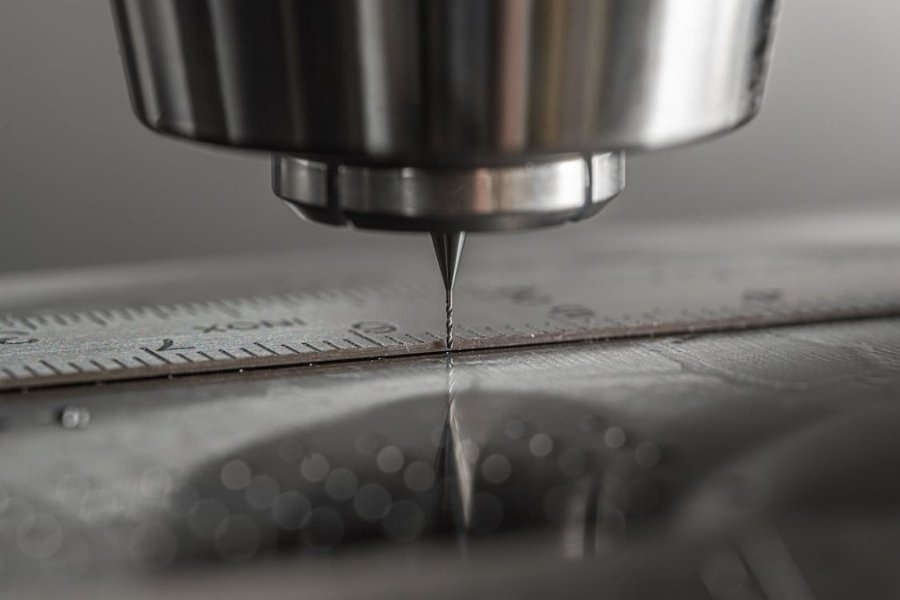
Multi-flute end mills don’t evacuate chips fast enough in acrylic. Chips re-cut at the tool, generate heat, and melt back onto the surface. We run O-flute (single-flute) spiral bits — designed for plastics, not repurposed from metal stock. This isn’t a preference. On parts requiring optical-grade surface quality, it’s the only option that achieves Ra 0.8μm without post-machining flame polishing.
3. Climb Milling on Finish Passes
Conventional milling pulls the workpiece and chatters on acrylic. Climb milling on finish passes eliminates chatter marks and reduces edge chip-out at corners. On parts with internal corners tighter than 2mm radius, we pre-drill entry holes before milling — acrylic cracks at abrupt direction changes when the bit is under load.
Tolerance Ceilings on CNC Acrylic Parts
Buyers coming from metal work often quote PMMA parts at ±0.005mm — the standard VNcontX tolerance for aluminum and stainless. That figure is achievable on metal. For acrylic CNC machining, the practical ceiling is different:
| Feature | Standard Tolerance | Notes |
|---|---|---|
| Linear dimensions | ±0.01mm | Consistent across cast PMMA; extruded adds ±0.02mm sheet variance |
| Hole diameter | ±0.02mm | Drill entry requires pilot hole to prevent crack propagation |
| Slot width | ±0.03mm | Affected by tool deflection on long-reach slots |
| Surface finish | Ra 0.8μm machined | Ra 0.4μm achievable with diamond-tip tool (lead time +2 days) |
| Flatness (panel) | ±0.1mm/100mm | Acrylic sheets carry inherent bow; vacuum fixturing required |
Design note: If your drawing calls for ±0.005mm on an acrylic part, flag it in the DFM review before production. We’ll clarify which dimensions actually require that tolerance and which can be relaxed — most acrylic applications don’t need metal-grade precision, and attempting it drives up cycle time with no functional gain.
Acrylic vs. Polycarbonate — Choosing the Right Optical Plastic
Buyers sourcing display panels or light diffusers often come in with “acrylic or polycarbonate” as an open question. The decision criteria are narrow but important:
Choose Cast Acrylic When:
- Optical clarity is the primary spec (92% light transmission vs. PC’s 88%)
- Part will not see impact loads
- UV exposure is a factor — PMMA is UV-stable without coating
- Scratch resistance matters (PMMA is harder than PC)
- Budget is a constraint — 20–30% cheaper than PC per kg
Choose Polycarbonate When:
- Part sees mechanical impact or repeated flex loading
- Operating temperature exceeds 80°C (PC rated to ~120°C)
- Thin wall < 2mm required — acrylic becomes brittle below 2mm
- Part needs fire-rated grade (UL94 V-0 available in PC)
- Complex internal geometry — PC tolerates more aggressive clamping
VNcontX machines both materials at the HCMC facility. If the application is genuinely ambiguous, we’ll run a DFM call before quoting — a 20-minute conversation that eliminates rework on the first article.
Surface Finishing Options for Machined Acrylic
Machined acrylic exits the spindle with a matte, slightly hazy surface — acceptable for structural applications, but not for optical or display parts. Four finishing paths are available:
-
As-Machined (Ra 0.8μm) Standard output. Acceptable for non-optical housings, test fixtures, and structural brackets. Light scatter visible at <15° viewing angle.
-
Diamond-Tip Polishing (Ra 0.4μm) Final pass with single-crystal diamond tool. Achieves near-optical clarity on flat and curved surfaces. Adds 2 days to lead time. Required for light-guide assemblies and sight glasses.
-
Flame Polishing Restores optical clarity to cut edges — particularly slots and bored holes. Not suitable for dimensionally critical features; slight thermal distortion is inherent. Best applied to cosmetic edges only.
-
Solvent Polishing Methylene chloride or acetone vapor polish for complex geometries where flame or diamond tools can’t reach. Used selectively on internal cavities. Dimensional control is approximate — not suitable where fit tolerances apply.
Common Applications Sourced Through VNcontX
Buyers from Australia, the US, and EU who source CNC acrylic service through VNcontX typically fall into three categories:
| Application | Material | Key Requirement | Typical Qty |
|---|---|---|---|
| Light guide panels (LED display) | Cast PMMA optical grade | Ra 0.4μm, edge clarity, ±0.01mm thickness | 50–500 pcs |
| Instrument sight glasses | Cast PMMA | Pressure-rated fit, O-ring groove tolerance ±0.02mm | 10–100 pcs |
| Machine enclosure panels | Extruded PMMA or PC | Flatness ±0.1mm/100mm, drilled and countersunk | 20–200 pcs |
| Prototype display bezels | Cast PMMA or PC | Snap-fit geometry, flush mating surface | 5–50 pcs |
| Microfluidic channels | Cast PMMA | Channel width ±0.02mm, bonding surface Ra < 0.4μm | 10–200 pcs |
No MOQ applies to any of the above. Prototype quantities from 1 piece. For optical-grade applications, send a marked-up drawing to duc.nguyen@vncontx.com before submitting a quote request — DFM feedback within one business day.
Sourcing Acrylic CNC Parts from HCMC — Logistics Fit for US & AU Buyers
For acrylic parts under 5kg — typical for display panels, light guides, and instrument components — air freight from Tan Son Nhat Airport in Ho Chi Minh City to Los Angeles runs 2–3 business days. Sydney is 1–2 days. Sea freight is viable only for larger panel orders where lead time isn’t a constraint.
Acrylic parts from Vietnam ship tariff-free to the US under most HS codes — unlike China-origin PMMA parts, which attract Section 301 duties at 25% or higher depending on classification. For Australian buyers, ASEAN-origin preference rates apply under ASFTA, reducing or eliminating import duty on most machined plastic components.
VNcontX is ISO 9001:2015 certified. Every order includes 100% FAI with Zeiss Contura CMM report. For optical-grade acrylic parts, we document surface finish measurements per ISO 1302 — exportable to your incoming inspection records.
For broader plastic machining requirements — POM, PEEK, ABS, PA66 — see CNC Plastic Machining Vietnam. For the full CNC capability overview including 5-axis and turning, see CNC Machining Services Vietnam. For prototype-first programs where acrylic is the bridge material before production tooling, see Rapid CNC Prototyping Vietnam.
Frequently Asked Questions — CNC Acrylic Machining
Get a Quote on Your Acrylic CNC Parts
Send a STEP or DXF file. DFM feedback within 1 business day. Prototype quantities from 1 piece. ISO 9001:2015. 100% FAI included.
Request a Technical Quote → Talk to an Engineer →