
Vietnam vs China CNC Machining Cost 2026: The Tariff Math Has Changed

For years, China set the global floor price on CNC machined parts. That calculation no longer holds. The US–China tariff stack in 2026 has fundamentally altered landed cost math — in ways that many procurement teams are still underestimating. This article breaks down the actual numbers: tariff layers, labor delta, freight comparison, and quality checkpoints. Vietnam is not a compromise. It is where the arithmetic now points.
The 2026 Tariff Stack on Chinese CNC Parts
CNC machined metal parts from China now carry four stacked duty layers when entering the US. These are not additive in all cases — Section 232 applies to the metal content value, not the full declared value — but the cumulative effect is severe for precision parts with high material content.
| Tariff Layer | Rate (China, 2026) | Rate (Vietnam) |
|---|---|---|
| Section 301 (Trade War) | 25% | 0% |
| IEEPA Reciprocal Tariff | 10% | 0% |
| Fentanyl IEEPA Surcharge | 10% | 0% |
| Section 232 (Steel/Aluminum content) | 25–50% on metal value | 0% |
| Effective stack — precision metal parts | 45–95%+ | 0% |
The figures above reflect the current structure as of May 2026. The US–China agreement reached in late 2025 extended 178 product exclusions through November 10, 2026, but these cover narrow categories — primarily solar manufacturing equipment and select medical devices. Standard precision CNC parts (HTS Chapter 84 machined components) are not excluded. Confirm your specific 10-digit HTS code with a licensed customs broker before drawing up any sourcing plan.
One line for your CFO: A $10,000 batch of aluminum-alloy CNC parts from a Chinese supplier now costs $14,500–$19,500 at the US receiving dock, before freight and insurance. The same parts from Vietnam cost $10,000–$11,000 all-in under equivalent quality specifications.
Real Landed Cost Comparison: $10,000 CNC Order
The example below uses a 200-piece run of aluminum 6061-T6 machined brackets, mid-complexity geometry, anodized finish. Part price sourced competitively in both countries at equivalent capability level.
China Origin
Vietnam Origin (VNcontX)
Note: Part prices are held equal to isolate the tariff variable. In practice, Vietnam-sourced precision parts run 10–20% lower on ex-works price for equivalent spec, widening the gap further. Tariff figures are estimates — verify current rates for your HTS code.
Quality: Where Vietnam Stands in 2026
The honest comparison requires acknowledging what China does well: Shenzhen and Dongguan clusters carry decades of accumulated tooling knowledge, dense subcontractor networks, and established quality management infrastructure. A top-tier Chinese shop at $50/hr machine rate running Fanuc 5-axis equipment produces excellent parts.
The gap closed significantly between 2018 and 2026. Vietnamese CNC facilities — particularly those in Ho Chi Minh City’s industrial corridor — now operate DMG Mori and Mazak equipment, run ISO 9001:2015 QMS, and deliver CMM-verified parts with Cpk ≥ 1.67. What changed: Vietnamese engineers who trained in Taiwan, Germany, and South Korea returned with both process knowledge and capital to acquire tier-1 machinery.
China — What you’re paying for
- Dense supply chain: Alloys, tooling, and surface finishing within 50 km in Guangdong clusters
- Volume economics: Hard to beat at 10,000+ pieces where amortized tooling cost matters most
- Established infrastructure: 30 years of precision machining ecosystem — specialist shops exist for every process
- Tariff exposure: 45–95%+ stacked duties eliminate the price advantage for US-destined parts
- IP risk: Documented history of reverse-engineering and unauthorized copy production
Vietnam — What changed
- Tier-1 equipment: DMG Mori 5-axis, Mazak QT turning centers now standard in HCMC facilities
- Tolerance parity: ±0.005mm standard | ±0.003mm precision — matched to German and Japanese benchmarks
- Zero tariff exposure: Section 301 does not apply. IEEPA baseline paused at 0% for Vietnam-origin goods
- EVFTA advantage: EU buyers additionally benefit from Vietnam–EU Free Trade Agreement preferential rates
- Lead time: 7–12 days standard CNC from Ho Chi Minh City — sea freight to West Coast 18–22 days, air to LAX 2–3 days
Lead Time Reality Check
Lead time comparisons between China and Vietnam often ignore port variability. In 2024–2025, congestion at major Chinese export ports caused significant schedule slippage on ocean freight. Cat Lai Port in Ho Chi Minh City — located under 25 km from VNcontX’s production facility — handles container throughput with shorter vessel queue times on most US-bound transpacific routes.
For urgent orders — first article samples, prototype validation, expedited production runs — VNcontX delivers FAI samples in 3–5 days and runs expedited CNC production in 5–7 days. Air freight from Tan Son Nhat Airport (24 km from the facility) to LAX lands in under 72 hours.
China Plus One: The Procurement Strategy That Now Applies to CNC
China Plus One is a diversification model borrowed from consumer electronics supply chains: keep China capacity for domestic or non-tariff-affected volumes, move US and EU-destined production to a secondary country. For precision CNC machining, most procurement teams dismissed this approach before 2023 — the quality differential seemed too large. The differential no longer exists at the tolerance bands that matter for industrial buyers: ±0.005mm to ±0.010mm.
The practical implementation for a US OEM: retain existing Chinese suppliers for parts with complex, China-specific tooling already amortized and domestic Chinese market distribution. Route all US-destined precision parts through a qualified Vietnamese supplier. On a $500,000 annual CNC spend, the tariff delta alone runs $225,000–$475,000 at the current 45–95% stack — the supplier qualification cost is recovered within the first order.
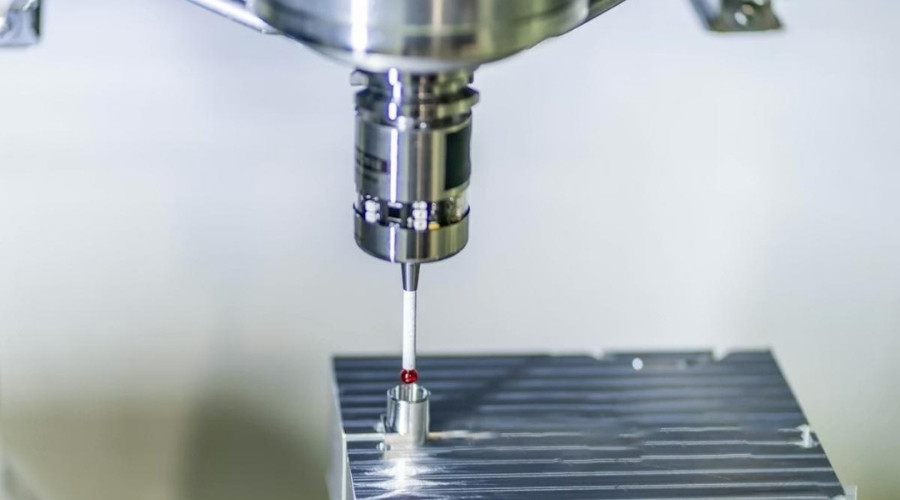
VNcontX carries ISO 9001:2015 certification, delivers 100% First Article Inspection with CMM report on every order (Zeiss Contura + Mitutoyo equipment), and maintains a Cpk ≥ 1.67 process capability index. For buyers running PPAP or FAI documentation requirements, this infrastructure is in place before the first RFQ.
Material Availability in Vietnam
One common objection: Vietnamese suppliers rely on Chinese raw material imports for specialty alloys, introducing a backdoor tariff risk. This is accurate for some metals at some facilities. At VNcontX, material sourcing runs through CO/CQ-traced supply chains — Certificates of Origin and Certificates of Quality ship with every order.
Stocked and short-lead-time materials include: aluminum 6061-T6, 7075-T6, 5052; steel 1018, 4140, 4340; stainless 303, 304, 316, 316L, 17-4 PH; titanium Grade 2, Grade 5 (Ti-6Al-4V); brass C360, C260; and engineering plastics including POM (Delrin), PEEK, PC, ABS, PA6/PA66. For buyers with custom alloy requirements outside this list, material procurement adds 3–5 days to the standard 7–12 day production window.
When China Still Makes Sense
A credible comparison requires acknowledging where China retains genuine advantages in 2026. Three scenarios where the calculus still favors China-origin production:
High-volume, low-tariff HTS codes. If your parts fall under one of the 178 active Section 301 exclusions, the tariff math changes. Verify your HTS code. Some narrow categories retain exclusion status through November 2026.
China domestic distribution. If your end customer or assembly plant is in China, the tariff argument inverts. Production and consumption in the same country — no cross-border duty applicable.
Ultra-complex supply chains with embedded Chinese tooling. Multi-stage production where Chinese specialty subcontractors hold proprietary tooling that cannot be transferred without 12+ months of re-qualification. In these cases, a parallel qualification program for simpler parts in Vietnam makes sense while the complex family remains in China.
Outside these three scenarios, the landed cost math for US and EU buyers points consistently toward Vietnam in 2026.
Frequently Asked Questions
Next Step: Benchmark Your Current China Spend
If your team is currently sourcing precision CNC parts from China and paying 45–95% stacked tariffs on top of part price, the arithmetic for switching to a qualified Vietnamese supplier works in your favor on the first order. VNcontX serves US companies through the CNC Machining Vietnam for US Companies program — structured specifically for buyers running dual-source qualification alongside existing supply chains. Engineers validating new designs can start with a rapid CNC prototype (FAI samples in 3–5 days) before committing to production volume. Full capability details at the CNC Machining Services page.
Send your CAD files and current China quote.
VNcontX will return a priced comparison within 24 hours — same spec, Vietnam-origin, zero Section 301 exposure.
Direct line: duc.nguyen@vncontx.com · (+84) 906 214 789
