
Based on DFM reviews across 200+ aerospace part numbers — structural brackets in 7075-T651, actuator housings in 17-4 PH, engine mount fittings in Ti-6Al-4V — the failure mode we see most often is not a machining problem. It’s a documentation gap. Parts land at incoming inspection, dimensions check out, and the order still stalls because the FAI balloon references don’t match the drawing rev, or the mill cert is missing a heat number. This article covers how VNcontX eliminates that gap: the aerospace CNC machining workflow, the documentation stack, and the specific technical requirements that separate an aerospace shop from a general job shop.
Why Aerospace CNC Machining Is a Different Conversation
General CNC shops quote to drawing. Aerospace CNC machining requires the shop to read the intent behind the drawing — then hold it across 50, 500, or 5,000 identical parts. The difference shows up in four areas buyers consistently flag:
- GD&T interpretation: True position, perpendicularity, and profile-of-a-surface callouts require CMM programming — not calipers. If the shop can’t load your STEP file into Zeiss Calypso and generate a balloon-referenced CMM report, it’s not an aerospace shop.
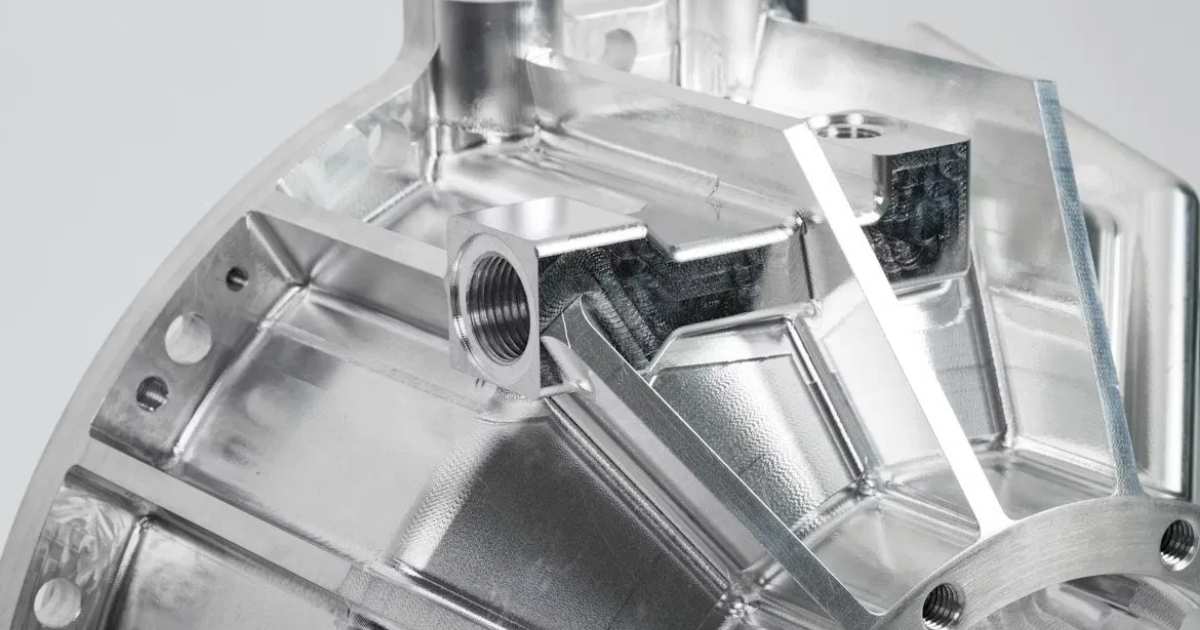
- Thin-wall stability: Aerospace brackets and structural ribs in 7075-T6 or Ti-6Al-4V routinely drop to 0.5–0.8mm wall sections. Fixture strategy and tool path sequencing determine whether the part springs or stays flat. This requires 5-axis simultaneous machining, not 3+2 positioning.
- Material traceability: The mill cert travels with the part. EN 9102 First Article, PPAP Level 3, or a customer-specific FAI format — the documentation package is not optional. It gets audited.
- Surface finish class: Ra 0.8μm is standard. Flight-critical bore surfaces often demand Ra 0.4μm or better. That requires CBN finishing passes, verified with surface profilometry — not visual inspection.
VNcontX operates with this context. Every CNC machining aerospace order runs through the Zero-Defect Protocol: DFM review before cutting, in-process SPC, and 100% CMM final inspection with a traceable report attached to the shipping documentation.
Aerospace Materials — Grades, Challenges, and What We Machine
Material selection in CNC machining for aerospace is not interchangeable. Each alloy behaves differently under cutting loads, and the machining parameters that work for 6061-T6 will destroy a Ti-6Al-4V part.
| Material | Grade | Aerospace Application | Key Machining Challenge |
|---|---|---|---|
| Aluminum | 7075-T6 / 7075-T651 | Structural frames, ribs, brackets | Residual stress — parts spring after roughing. Requires stabilization cycle before finish pass. |
| Titanium | Grade 5 (Ti-6Al-4V) / Grade 23 | Fastener holes, structural fittings, engine mounts | Work-hardening and heat generation. Low SFM, high-pressure coolant mandatory. Tool life closely monitored. |
| Stainless Steel | 17-4 PH (H900/H1025) / 316L | Actuator components, fluid system fittings | 17-4 PH work-hardens rapidly. Precipitation hardening must occur before final machining of critical dimensions. |
| Steel | 4340 / 4140 (normalized or HT) | Landing gear components, drive shafts | High hardness after heat treatment (up to 52 HRC). Requires CBN inserts for finish passes. |
Material cert requirement: All aerospace-grade stock arrives with mill certs (heat/lot traceable). Certs are retained on file and attached to the FAI package. If a customer requires an independent material verification (PMI or spectrometer check), this is performed at VNcontX before cutting begins.
5-Axis Simultaneous Machining for Complex Aerospace Geometry
The standard argument for 5-axis CNC machining in aerospace is fewer setups, better surface finish, and consistent datum control. The real value for aerospace work is positional accuracy across multiple features in a single clamping.
When you machine a titanium structural fitting with three bolt-hole patterns at different compound angles, the true position of each pattern relative to the datum A-B-C scheme is what the CMM will measure against. Every re-clamp introduces uncertainty. Five-axis simultaneous eliminates that uncertainty for most complex geometries.
At VNcontX, the DMG Mori 5-axis platform holds:
- Linear positioning accuracy: ±0.002mm (machine calibrated quarterly)
- Circular interpolation: ±0.003mm on 100mm radius test arc
- Spindle thermal compensation: active during long-cycle titanium programs
- Tool length measurement: on-machine Renishaw probe before each finish tool engagement
For cnc machining aerospace parts requiring ±0.005mm standard or ±0.003mm precision tolerance, all final dimensions are verified by Zeiss Contura CMM using Calypso software. The CMM report maps directly to the drawing balloon numbers.
FAI and Documentation — What the Package Includes
An aerospace buyer’s first question about any offshore CNC machining service is never “how cheap?” — it’s “what do I get when the parts arrive?” Documentation is the answer. Without it, parts sit in incoming inspection indefinitely.
| Document | Standard Included | Notes |
|---|---|---|
| CMM Dimensional Report | Yes — 100% of parts | Balloon-referenced to customer drawing. Zeiss Calypso output. PDF + native file available. |
| Material Certificate | Yes — heat/lot traceable | Mill cert forwarded. PMI/spectrometer on request. |
| Surface Finish Report | Yes — Ra value per callout | Mitutoyo SJ-210 profilometer. Critical surfaces measured and recorded. |
| First Article Inspection (FAI) | Yes — every new part number | AS9102B format on request. Includes ballooned drawing, dimensional data, material cert, finish data. |
| Certificate of Conformance (CoC) | Yes | Signed, dated, references drawing rev, material, finish spec, and applicable standards. |
| Process Control Records | Yes — in-process SPC data | Cpk/Ppk data on critical dimensions for production runs. |
AS9100 status: VNcontX operates under ISO 9001:2015 with AS9100-aware process discipline. Full AS9100 Rev D certification is in scope for 2026 Q4. Buyers operating under AS9100-registered supply chain requirements should confirm applicability with their quality team before order placement.
Surface Finishing for Aerospace-Grade Parts
Dimensional accuracy and surface finish are separate conformance gates. VNcontX processes the full aerospace finishing spectrum in-house or through Verified Partner finishing shops operating under the same Zero-Defect Protocol:
- Anodize Type II & III (MIL-A-8625F): Class 1 (undyed) and Class 2 (dyed). Hard anodize (Type III) for wear surfaces. Thickness per spec, verified by eddy-current gauge.
- Passivation (ASTM A967 / AMS 2700): Stainless steel components — removes free iron, restores corrosion resistance. Method A (nitric acid) or Method E (citric acid) per customer spec.
- Electroless Nickel (ASTM B733): Uniform coating on complex geometry. Class 4 / 6 / 7 available. Hardness up to 70 HRC post-bake.
- Chem Film / Alodine (MIL-DTL-5541): Aluminum components requiring electrical conductivity retention. Type 1 and Type 2.
- Black Oxide (MIL-DTL-13924): Steel components. Class 1 standard.
- Laser Marking: Part number, serial, drawing revision — permanent, non-dimensional-affecting.
Typical Aerospace Parts We Machine
| Part Type | Material | Tolerance Class | Volume Range |
|---|---|---|---|
| Structural brackets & ribs | 7075-T6 Al | ±0.005mm / GD&T | 10–500 pcs |
| Actuator housings | 17-4 PH SS | ±0.003mm precision | 5–200 pcs |
| Engine mount fittings | Ti-6Al-4V Gr5 | ±0.005mm / true position | 1–50 pcs |
| Hydraulic manifold blocks | 6061-T6 / 7075-T6 | ±0.005mm port threads | 10–300 pcs |
| Control surface linkages | 4340 steel (HT) | ±0.005mm bore | 25–500 pcs |
| UAV / drone frame components | 7075-T6 / Ti Gr5 | ±0.005mm | 10–2,000 pcs |
Vietnam vs Other Offshore Options for Aerospace Machining Companies
| Factor | Vietnam (HCMC) | India (Pune / Chennai) | Eastern Europe (CZ / PL) |
|---|---|---|---|
| Section 301 Tariff to US | 0% | 0% | 0% |
| Air freight to US West Coast | 2–3 days | 3–5 days | 5–7 days |
| Timezone overlap with US (EST) | 11–12 hrs ahead | 9.5–10.5 hrs ahead | 5–6 hrs ahead — strong overlap |
| CMM FAI documentation maturity | High — Zeiss Calypso standard | Variable by shop | High — EU aerospace supply chain |
| 5-axis DMG Mori availability | Yes — on-site HCMC | Available at Tier-1 shops | High density |
| EVFTA (EU export tariff) | 0% under EVFTA | Standard MFN rates apply | EU member — free movement |
| Landed cost vs China (post-tariff) | 30–40% lower | 20–35% lower | 10–20% lower |
The practical difference:
Vietnam-origin parts are Section 301 duty-free from Vietnam — 0% on all machined components entering the US under current USTR schedule.
Eastern Europe wins on timezone for real-time engineering calls. Vietnam wins on air freight speed to the US West Coast and landed cost. For US aerospace buyers prioritizing FAI package quality and fast prototype turnaround, Vietnam’s combination of 2–3 day air freight and established CMM workflow is difficult to match at equivalent price points.
FAQ — Aerospace CNC Machining Vietnam
VNcontX supplies aerospace-grade CNC machined components to buyers in the US and Australia. Our facility runs DMG Mori 5-axis machines with ±0.005mm tolerance, 100% FAI on every order, and 98.4% OTD. Lead time 7–12 days standard, 3–5 days for FAI samples. Learn more about our CNC machining services for US companies or our dedicated program for Australian manufacturers sourcing from Vietnam.
Send Your Aerospace Drawing for Technical Review
DFM feedback within 24 hours. CMM FAI on every order. Full documentation package included.
Request a Technical Quote →
Talk to an Engineer →
duc.nguyen@vncontx.com | | Bình Chánh, Ho Chi Minh City
