Vietnam Manufacturing Quality in 2026: What the Data Actually Shows
The perception that Vietnam manufacturing quality is unreliable for precision work is not new — and it is increasingly disconnected from what’s happening on the ground. It persists largely because buyers who had a bad experience with a single unvetted supplier in 2018 are still writing the playbook for their procurement team in 2026.
This article does not argue that all Vietnam manufacturers are good. They are not. What it does is present what independent, third-party data — from the OECD, World Bank, and observable FDI flows — actually says about Vietnam manufacturing quality at the industry level, and where real gaps remain. The goal is to give a procurement engineer a calibrated picture, not a sales pitch.
Why the Outdated Perception Exists — and Why It’s Shifting
Where the reputation came from
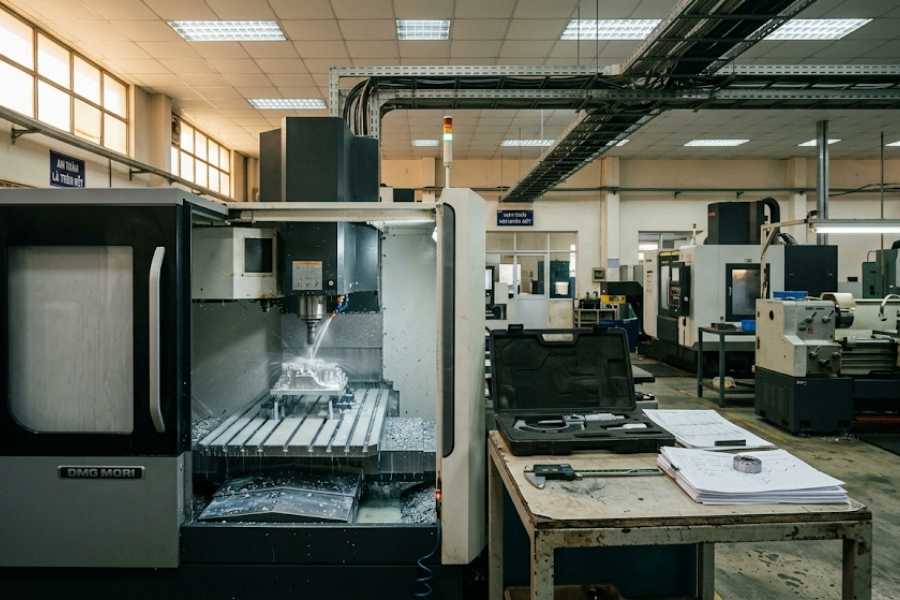
Vietnam’s manufacturing export identity through the 2000s was built on three sectors: textiles, footwear, and basic electronics assembly. All three are labor-intensive, tolerance-insensitive, and heavily dependent on imported components. The quality narrative that developed around those sectors — “cheap, acceptable, not precision” — made sense at the time. Vietnam manufacturing standards in that era reflected a workforce and capital base optimized for volume and cost, not dimensional accuracy.
What the capital flows say about 2026
What changed is where the money went. Manufacturing’s share of Vietnam’s GDP rose from under 8% in 1990 to 27% by 2022, driven by FDI inflows averaging 4.8% of GDP annually between 2015 and 2023. That rate exceeded every ASEAN peer, India, and China during the same window, according to OECD data published in 2025. In 2024 alone, Vietnam’s manufacturing and processing sector attracted US$25.58 billion in FDI — 66.9% of all foreign investment into the country that year. That capital did not go into more T-shirt factories.
The composition shift matters directly for vietnam precision manufacturing buyers. Capital equipment investment at scale — CMMs, 5-axis machining centers, wire EDM, cleanroom injection systems — requires a reason to exist. That reason is customer programs demanding the tolerances those machines are built to hold.
The Samsung, Intel, and LG Signal
Why MNC investment is a quality proxy
Three companies are worth examining as proxies for what a serious manufacturing quality audit of Vietnam actually found, because all three ran formal supplier qualification processes before committing capital at scale. Vietnam supplier quality assessment at the tier-1 level is not a shortcut process at Samsung or Intel — it involves multi-year qualification cycles, process audits, and documented corrective action history.
| Samsung Group | Cumulative investment: US$24 billion. Six manufacturing facilities across Bac Ninh, Thai Nguyen, Hanoi, and HCMC. By end of 2025: revenue from Vietnam operations reached US$64.9 billion with export turnover of US$57.1 billion. Over 50% of Samsung’s global mobile phone output is produced at Vietnam facilities. A US$1.5 billion semiconductor testing plant (first in Vietnam) is under construction in Thai Nguyen, with operations scheduled for late 2027. |
| Intel Products Vietnam | Total pledged investment: US$4.115 billion as of Q1 2026. Location: Saigon High-Tech Park, HCMC. Status: Intel’s largest assembly and test facility globally — not regionally, globally. |
| LG Innotek | June 2026: signed MOU with Hai Phong to build a semiconductor substrate production facility. Described as part of a formal “dual-manufacturing strategy” — meaning Vietnam is not a backup, it is a primary production base. |
The relevance for a procurement engineer is not that these companies are impressive. It is that Intel, Samsung, and LG all ran multi-year supplier qualification processes before committing this capital. They audited manufacturing quality across the country. They found what they needed to justify the investment. That finding is reflected in the money, not in a marketing brochure.
According to OECD Economic Surveys: Viet Nam 2025, Samsung alone accounts for approximately one-fifth of Vietnam’s total national exports — a concentration level that Samsung’s supply chain team does not accept without demonstrated and sustained quality control across the local supplier base.
What ISO 9001 Density Actually Tells You — and What It Doesn’t
ISO 9001 as a market signal, not a capability guarantee
ISO 9001:2015 is now a baseline entry requirement for any contract manufacturer in the HCMC–Binh Duong–Dong Nai industrial corridor that sells to export programs. Facilities without it are excluded from Tier 1 and Tier 2 supply chains by customer quality requirements before the technical conversation starts.
This matters less as a quality guarantee and more as a market signal: the certification density in this corridor reflects the buyer base that Vietnam’s export manufacturers have been serving for the past decade. Companies like Bosch, Foxconn, and Toyota require ISO 9001 from their suppliers. Their suppliers require it from sub-suppliers. Vietnam manufacturing standards in the export corridor propagated through the regional supply chain by commercial pressure, not regulatory mandate.
What certification doesn’t cover
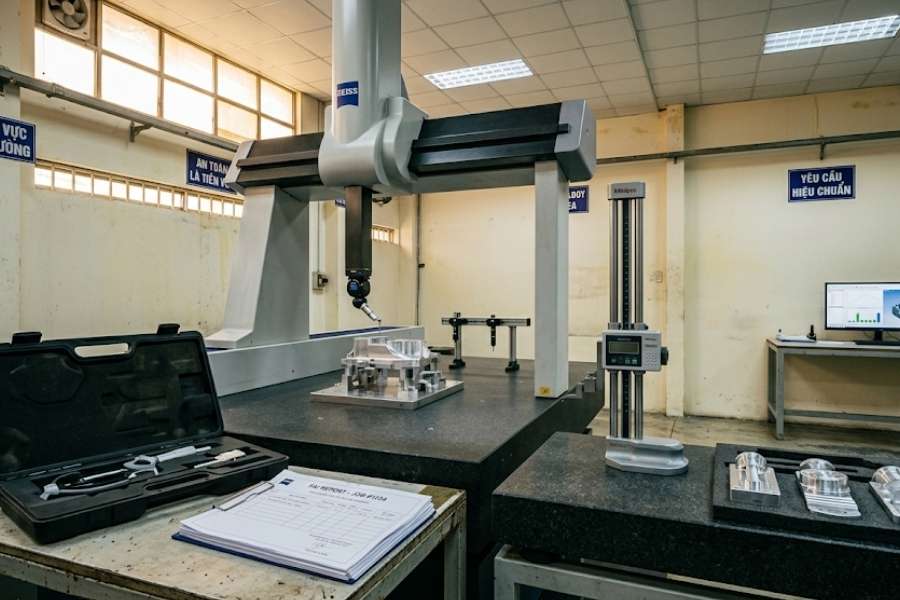
What ISO 9001 does not guarantee: that the facility can hold ±0.005mm in production. Certification covers process discipline — documented procedures, corrective action systems, calibration records. Dimensional capability is determined by equipment, fixturing, operator skill, and environmental controls. These need to be verified separately, which is where CMM reports, Cpk data, and FAI documentation become the relevant evidence.
For buyers who want to understand how to verify tolerance capability at a specific facility before committing an order, see our detailed breakdown on precision machining quality control standards.
Where Vietnam Manufacturing Quality Still Has Real Gaps
An honest assessment for procurement engineers
Any analysis that doesn’t address genuine weaknesses is not an analysis — it’s a marketing document. Here is what is actually uneven in Vietnam’s precision manufacturing sector as of 2026.
The distance between a qualified export-focused precision shop and a domestic-market workshop in Vietnam is larger than in Taiwan, South Korea, or Germany. Both may carry ISO 9001 certification. The difference appears in machine vintage, CMM availability, English-language DFM communication, and documented corrective action processes. Buyers who RFQ blind to a list of “ISO 9001 Vietnam” results will encounter this gap directly. Supplier qualification process matters more here than in markets where the floor is higher.
Titanium alloys, PEEK, certain high-performance tool steels (H13, S136), and specialty stainless grades still require import lead times from Japan, South Korea, or Europe. A facility quoting 7–12 day CNC lead time needs to already have material in stock, or that lead time expands. Qualified facilities plan for this and quote accurately. Unqualified ones absorb the gap with optimistic quotes and delivery surprises.
AS9100D (aerospace), IATF 16949 (automotive), and ISO 13485 (medical devices) coverage is limited relative to Taiwan, South Korea, or even Thailand. For buyers in regulated programs that require these certifications by contractual or regulatory mandate, the qualified Vietnam supplier pool narrows significantly. The facilities exist, but there are fewer of them. Verify certification status directly — do not rely on marketing claims.
Managing a complex first article remotely — drawing review, tolerance stack analysis, DFM changes mid-run — requires English-language technical fluency that varies significantly across facilities. Shops that have built their business primarily on domestic programs often lack this capability. For facilities that export consistently to US, EU, or Australian buyers, it is a basic operational requirement. Ask for a DFM response on a sample drawing during qualification — it is a fast filter.
The Accurate Picture for a Procurement Engineer
Vietnam manufacturing quality at the ±0.005mm precision level is real, available, and supported by a supply chain infrastructure that $24 billion of Samsung investment, $4 billion of Intel investment, and a decade of Tier 1 supplier development has built. The country’s GDP grew 8% in 2025, driven by manufacturing exports. FDI into manufacturing hit US$25.58 billion in 2024. These are not vanity metrics — they are the output of quality audits run by procurement engineers at companies that do not tolerate failure. The gaps are real too: the tier structure is uneven, regulated certifications are sparse, and specialty material lead times require planning. Knowing both sides is what makes supplier selection work. Once you have decided Vietnam is worth evaluating, the next step is qualifying a specific facility — not the country. Our Vietnam manufacturer audit checklist gives you the exact documents to request, how to verify an ISO certificate independently, and the eight red flags that predict production problems before you place a deposit.
For a closer look at how contract manufacturing is structured in Vietnam and what to evaluate when qualifying a facility, the contract manufacturing Vietnam overview covers facility requirements, lead times, and documentation standards. For US-based buyers evaluating CNC machining specifically, the Vietnam CNC machining guide for US companies addresses tariff exposure, logistics, and quality verification in more detail.
Evaluating a Vietnam Precision Manufacturer?
VNcontX — ISO 9001:2015 certified, Bình Chánh, HCMC. ±0.005mm CNC machining, injection molding, sheet metal. Zeiss Contura CMM FAI on every order. 98.4% OTD. Air to US/AU: 2–3 days.
Request a Technical Quote → Talk to an Engineer →duc.nguyen@vncontx.com ·
