
Vietnam Export Documentation for US Importers — What to Expect with Every Shipment
vietnam export customs documents
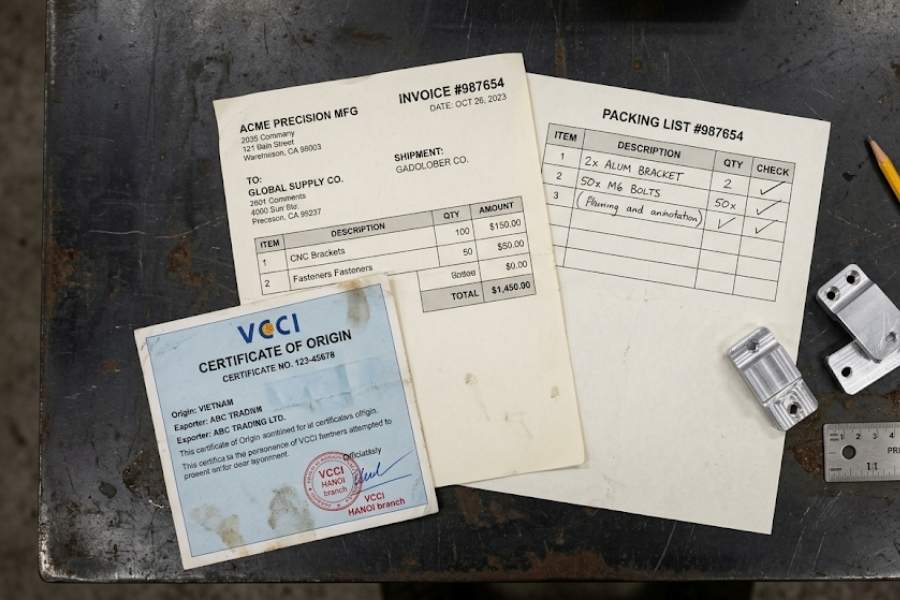
Vietnam export customs documents are not complicated — but missing one, or receiving one with incorrect data, stalls your shipment at US Customs & Border Protection (CBP). This guide covers every document in a standard Vietnam-to-US manufacturing shipment: what each one is, who issues it, what CBP requires, and the specific errors that cause delays. Use the 12-point checklist at the end to verify your documentation package before goods ship.
If you’re sourcing CNC machined parts or precision components from Vietnam for your US company, your supplier relationship includes a documentation workflow. Most buyers encounter their first documentation issue on shipment two or three — not shipment one — because everything moves fast on a first order. This guide exists so that doesn’t happen to you.
The Standard Documentation Package from a Vietnam Supplier
A complete documentation package for Vietnam-to-US manufactured goods typically contains seven to nine documents depending on material, commodity type, and trade agreement eligibility. The core set required for CBP entry is consistent across virtually every shipment of manufactured parts.
Core set (always required): Commercial Invoice · Packing List · Bill of Lading or Airway Bill · Certificate of Origin · Importer Security Filing (ISF/10+2 data, filed by your customs broker 24 hours before vessel departure).
Additional documents — CMM inspection reports, material certifications, test reports — are not required by CBP for customs entry but are required by your receiving process, your quality team, or your customer’s specifications. Treating them as optional is the mistake that creates receiving rejections.
The documents below are organized in the order your customs broker will ask for them, not alphabetically.
Certificate of Origin: Form E vs Ordinary C/O — What Vietnam Issues
The Certificate of Origin (C/O) is the single most misunderstood document in Vietnam-to-US trade. There are two distinct types, and they serve completely different purposes.
- Exporter name and address matches your Commercial Invoice exactly (character for character)
- Consignee name matches your ISF filing
- Description of goods is consistent across all documents
- Country of origin stated as “VIETNAM” — not a city or province name
- VCCI stamp and authorized signature present — unsigned C/O is invalid
- C/O number recorded in your files for CBP audit trail
A common error: buyers importing aluminum CNC parts ask specifically about “Form E” after reading a general Vietnam trade article. Form E is for intra-ASEAN and ASEAN–China trade. For US imports, the ordinary VCCI C/O is what CBP will examine. For a full breakdown of incoterms and how they interact with origin documentation, see our guide to incoterms vietnam manufacturer.
Commercial Invoice: What US Customs Requires
The Commercial Invoice is CBP’s primary valuation document. It determines the dutiable value of your goods, which affects the tariff amount calculated. Errors on the commercial invoice are the leading cause of customs holds on manufactured parts shipments from Vietnam.
- Invoice value matches your purchase order — no rounding or currency conversion errors
- Description is specific: “CNC machined aluminum bracket, 6061-T6” not “metal parts”
- Incoterm stated and consistent with your agreement (FOB, EXW, DAP, etc.)
- Country of origin: “Vietnam” — standardized wording
- No dual invoicing — CBP takes undervaluation seriously; the price on the invoice must be the actual transaction value
Undervaluation risk: Some buyers ask suppliers to declare a lower value to reduce duty. This is customs fraud. CBP has access to pricing benchmarks and flags anomalies. The penalty can exceed the original shipment value. VNcontX declares actual transaction values on all invoices.
Packing List: Why Detail Matters for HTS Classification
The Packing List is a line-item breakdown of every item in the shipment — box by box, item by item. CBP uses it to verify the commercial invoice and to conduct targeted physical inspections. Your customs broker uses it to support HTS classification.
- Total quantity matches purchase order and commercial invoice
- Total gross weight is plausible — if dramatically off, flag before loading
- Part numbers match your internal BOM / PO line items
- Each box numbered and cross-referenced — helps CBP select box 3 of 12 rather than unpacking everything
CMM Inspection Report and Certificate of Conformance: Receiving Requirements
CBP does not require dimensional inspection reports for customs entry. Your receiving dock does. More importantly, your customers — especially aerospace, medical device, and defense buyers — typically require an inspection certificate or dimensional report as a condition of acceptance.
- Report references your part number and revision level — not a previous revision
- All critical dimensions called out on your drawing are present in the report
- All values within tolerance — any out-of-tolerance result should be accompanied by a nonconformance report (NCR)
- Report dated within the shipment’s production run — not a historical report from a prior order
- Authorized signature from QC — not a generic stamp
- Correct PO number and revision level cited
- Date is current — not a pre-printed template date
Material Certifications: Mill Cert Format from Vietnam Suppliers
Material certifications (mill certs) are issued by the raw material manufacturer, not by your machining supplier. The machining supplier is responsible for requesting them when they purchase raw material and passing them through to you with the shipment.
- Material spec on cert matches your drawing callout exactly (e.g., “6061-T6 per ASTM B209” not just “aluminum 6061”)
- Heat/lot number traceable to the material used in your production run — ask supplier to confirm traceability at time of PO
- Mill cert is original from the mill, not a retyped or reformatted summary
- For stainless steel: confirm 304 vs 316 grade is correct — most common material substitution error in the industry
Request material certs at PO issuance, not at shipment time. Traceability requires the cert matches the specific heat/lot used to machine your parts. If you request it after production, the supplier can provide a cert for the right material type but may not be able to prove traceability to your exact production run. Make it a PO line item requirement.
How the C/O Process Actually Works — Timeline from Your Vietnam Supplier
Understanding the C/O issuance process helps you set realistic timelines and avoid last-minute requests that create errors.
C/O cannot be applied for until the goods exist and quantities are confirmed. An invoice issued before packing is complete often has errors that create C/O mismatches downstream.
The supplier submits the C/O application to VCCI with the commercial invoice, packing list, and export license if applicable. All three must be consistent — VCCI rejects applications with discrepancies.
Standard processing is 1–3 business days. The C/O is issued with a unique reference number. Expedited is possible at some VCCI offices.
Original paper C/O typically travels with the goods or is couriered separately. Electronic copy is sent immediately. Confirm with your customs broker which format they need for CBP entry.
Timeline implication: If your goods are shipping FOB Cat Lai Port (20–25km from VNcontX’s facility in Bình Chánh), the C/O is typically finalized 2–4 days before vessel departure. Build this into your production schedule — not an afterthought at booking time.
Common Documentation Errors That Delay Customs Clearance
These errors account for the majority of customs holds and release delays on Vietnam-to-US manufactured goods shipments. Most are preventable with a pre-shipment document review.
| Document | Common Error | Consequence |
|---|---|---|
| Commercial Invoice | Value discrepancy between invoice and bank wire records | CBP formal entry examination, potential penalty assessment |
| Commercial Invoice | Description too vague (“metal components”) | HTS classification challenged; delay for additional information request (CF-28) |
| C/O (VCCI) | Exporter name on C/O doesn’t match invoice | C/O rejected as invalid; CBP treats goods as origin unknown |
| C/O (VCCI) | Missing VCCI stamp or authorized signature | C/O invalid; must request corrected version — 3–7 day delay minimum |
| Packing List | Total quantity doesn’t reconcile with invoice | Shipment flagged for discrepancy resolution |
| ISF 10+2 | Filed late (less than 24 hours before vessel departure) | CBP $5,000 penalty per violation; shipment may be detained |
| Mill Certificate | Cert provided for wrong heat/lot number | Receiving rejection; production line hold if traceability can’t be restored |
| CMM Report | Report references wrong drawing revision | Quality hold at receiving; may require re-inspection or return |
Checklist: 12 Documents to Request Before Goods Ship
Documents marked “Always” should be standard on every shipment. Documents marked “When applicable” depend on your part type, industry, and PO requirements.
Pro practice: Add the document checklist as a line item in your purchase order terms. Include the specific format required (e.g., “CMM report referencing revision B drawing with balloon numbers”) and the deadline (e.g., “all documents emailed 48 hours prior to vessel departure”). This removes ambiguity and creates an enforceable record.
Section 301 Tariffs and Vietnam Origin: What Documentation Proves
US buyers sourcing from Vietnam to avoid Section 301 tariffs on Chinese goods (currently up to 145% on many HTS categories) need to understand what CBP actually examines to confirm Vietnamese origin. The Certificate of Origin confirms the country where goods were produced. But CBP’s concern with Vietnam sourcing is whether goods were substantially transformed in Vietnam or merely transshipped from China.
For CNC machined parts and injection-molded components, the documentation supporting a genuine Vietnam-origin claim includes:
- → Material certifications showing raw material sourced from non-Chinese mills
- → Production records showing machining was performed in Vietnam (ISO 9001:2015 documentation)
- → VCCI-issued Certificate of Origin with correct HS code and country-of-origin statement
- → Supplier’s manufacturing facility address — confirming production is in Vietnam, not a trading company address
VNcontX operates a manufacturing facility in Bình Chánh District, Ho Chi Minh City. All machining and production is performed on-site. We do not transship Chinese-origin goods. Our documentation is structured to withstand CBP scrutiny. For a full breakdown of which HTS codes are affected and current tariff rates, see our guide to Section 301 tariffs on machined parts. For the full picture on how contract manufacturing Vietnam documentation is structured, that page covers our facility and QC process.
5 Questions to Ask Your Customs Broker Before Your First Vietnam Shipment
Your customs broker handles CBP entry — but you need to give them complete documentation and clear instructions. Before your first shipment from a Vietnam manufacturer, confirm these five points with your broker directly.
Provide your broker with the commercial invoice description, packing list, and any technical drawings. HTS classification determines your duty rate. If the classification is uncertain, request a binding ruling from CBP — this protects you from retroactive duty assessments and gives you a defensible position if audited.
Vietnam-origin goods are exempt from Section 301. Confirm your HTS code isn’t subject to any separate anti-dumping or countervailing duty orders affecting Vietnam specifically. Your broker can check USITC and CBP databases in under 5 minutes.
CBP requires ISF filing at least 24 hours before vessel departure from Vietnam. Your broker files this — but you need to provide supplier name, address, and shipment data in time. Confirm their internal cutoff, which is typically 48–72 hours ahead of the vessel deadline. Missing this triggers a $5,000 CBP penalty per violation.
CBP accepts electronic copies for most entries. Some brokers prefer originals for their audit files. Confirm before your supplier ships the document — original C/Os couriered separately add 3–5 days and create a window where goods arrive before documentation does.
Some commodity types — certain steel products, electronics components, medical device subcomponents — receive additional CBP scrutiny on Vietnam-origin shipments. An experienced broker who handles Vietnam manufacturing imports regularly will know current examination patterns for your HTS code and can flag what to prepare before it becomes a hold.
First shipment setup takes 2–3 weeks to do correctly. HTS binding ruling, ISF data setup, customs broker briefing, and C/O format confirmation are all one-time tasks. After the first shipment clears cleanly, repeat orders follow the same process with minimal friction.
Frequently Asked Questions
Ready to Source from Vietnam? We Handle the Documentation.
VNcontX provides a complete documentation package with every shipment: commercial invoice, VCCI C/O, packing list, CMM reports, and material certs on request. ±0.005mm tolerance · DMG Mori 5-axis · 7–12 days production · Air to LAX 2–3 days · ISO 9001:2015 · 98.4% OTD. For transit times and freight costs from Vietnam to the US, see our shipping from Vietnam to USA guide.
Request a Technical Quote → Talk to an Engineer →