
Polycarbonate, Nylon & PEEK Injection Molding — Processing Parameters & Design Notes
By VNcontX Engineering ·
Polycarbonate injection molding, nylon (PA6/PA66), and PEEK cover the upper tier of thermoplastic injection molding — resins specified when ABS cannot meet the heat, structural, or chemical requirement. This guide documents the processing window, failure modes, and design constraints for each resin, drawn from production runs at our facility in Ho Chi Minh City.
ABS is the default for a reason — it’s forgiving, cheap to dry, and tolerates a wide barrel window. But the moment a part needs optical clarity, continuous-use heat resistance, chemical exposure, or structural load under temperature, ABS stops being a material and starts being a compromise. The resins below are the correct alternatives, each with trade-offs that need to be understood before tooling is cut.
Polycarbonate (PC) Injection Molding
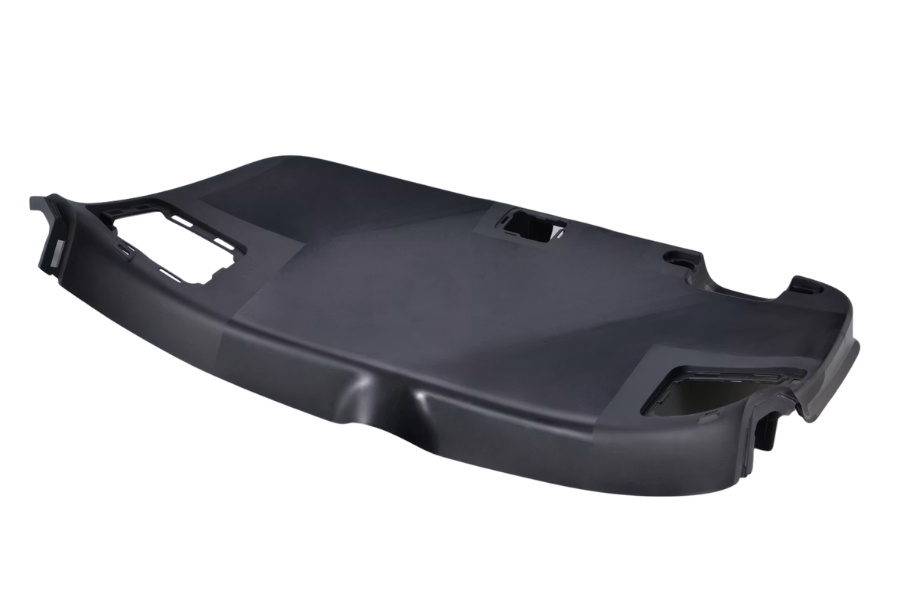
Polycarbonate is the resin engineers reach for when the part needs impact resistance that ABS can’t deliver, optical clarity, or a continuous-use temperature above 100 °C. It’s also one of the more unforgiving resins to process — moisture, gate geometry, and wall transitions all have outsized effects on the finished part.
| Parameter | Standard Grade | Notes |
|---|---|---|
| Melt Temperature | 280–320 °C | Higher end for thick walls or glass-filled grades |
| Mold Temperature | 80–120 °C | Higher mold temp reduces internal stress; critical for optical parts |
| Drying | 120 °C / 4–6 hrs | Moisture >0.02% causes silver streaks and splay — non-negotiable |
| Injection Speed | Low–medium | High speed creates shear stress and jetting at thin gates |
| Shrinkage | 0.5–0.7% | Predictable; less post-mold warpage than PA or POM |
| Wall Thickness | 1.5–4mm recommended | Below 1.2mm at this viscosity risks incomplete fill without high injection pressure |
Common Failure Modes in PC Parts
The majority of first-shot rejections in polycarbonate injection molding come from three sources:
- Splay / silver streaks — moisture in resin before molding. Fix: pre-dry at 120 °C min 4 hrs, check hopper temperature
- Cracking near gate — shear stress from undersized or pin-point gates. Fix: minimum gate diameter 1.0mm for wall ≥2mm; prefer edge or submarine gate
- Warpage on flat faces — asymmetric cooling from uneven wall thickness. Fix: maintain wall uniformity ±20%; increase mold temperature to 100 °C+
- Stress whitening — sharp corners under load. Fix: minimum corner radius R = 0.5× wall thickness on the drawing
PC does not respond well to chemical release agents. For optical-grade parts, mold steel should be polished to SPI A-1 or A-2 and release agent eliminated from the process. Specify this in your RFQ.
Nylon Injection Molding — PA6 and PA66
Nylon is the structural workhorse of engineering plastics. PA66 runs at a higher melt temperature than PA6 and delivers better fatigue and heat resistance; PA6 has slightly better impact toughness and is cheaper per kg. For mechanical parts — gears, brackets, snap-fits, clips — both outperform ABS injection molding on tensile and flex modulus.
The critical characteristic of nylon that engineers underestimate: it is hygroscopic. PA6 can absorb up to 3.5% moisture at equilibrium. That moisture changes dimensional stability — parts that pass CMM inspection at molding can shift by 0.15–0.3mm in humid environments. If your application has tight running clearances, this must be accounted for in your tolerance stack.
| Parameter | PA6 | PA66 |
|---|---|---|
| Melt Temperature | 230–260 °C | 260–290 °C |
| Mold Temperature | 60–90 °C | 70–100 °C |
| Drying | 80 °C / 4 hrs | 80 °C / 4–6 hrs |
| Shrinkage (unfilled) | 0.6–1.4% | 0.5–1.5% |
| Shrinkage (GF30) | 0.3–0.6% | 0.25–0.5% |
| Max Continuous Temp | 105 °C | 130 °C |
Glass-Filled PA66 — What Changes
GF30 (30% glass fiber) is the most common structural upgrade. Tensile strength roughly doubles versus unfilled PA66 and heat deflection temperature rises to ~240 °C. The trade-off: the fiber orientation follows flow direction, creating anisotropic shrinkage. Parts with asymmetric ribs or off-center gates warp predictably along the fiber axis. Gate location becomes a structural decision, not just a flow decision.
We recommend requesting a Moldflow simulation report before cutting steel on GF30 parts with long flow lengths or thin rib geometry. This is available as part of our DFM review process.
Nylon parts measured immediately after molding are smaller than their conditioned dimensions. Allow 24–72 hrs before CMM measurement, or specify the test condition (dry-as-molded vs. equilibrium at 50% RH) on the drawing. We default to dry-as-molded unless your drawing specifies otherwise.
PEEK Injection Molding
PEEK (polyetheretherketone) sits at the upper end of thermoplastic injection molding in terms of both performance and process difficulty. Continuous-use temperature to 260 °C, chemical resistance to virtually all organic solvents, excellent fatigue strength, and sterilization compatibility — PEEK is specified in aerospace, semiconductor, and medical-grade component applications where no lower-cost resin meets the spec.
The processing challenge: PEEK requires a barrel temperature of 360–400 °C, which is 80–120 °C above the processing window of PC or GF-PA66. Standard injection machines run to ~350 °C barrel max. PEEK requires a dedicated high-temperature press with reinforced screw and barrel — running PEEK on a standard machine degrades the resin and damages the equipment. We run PEEK on quoted projects with confirmed volume; contact us to discuss feasibility before submitting a drawing.
| Parameter | Unfilled PEEK | CF/GF-PEEK |
|---|---|---|
| Melt Temperature | 360–400 °C | 360–400 °C |
| Mold Temperature | 160–200 °C | 160–190 °C |
| Drying | 150 °C / 3–4 hrs | 150 °C / 3–4 hrs |
| Shrinkage | 1.2–2.4% | 0.1–0.5% |
| Continuous Use Temp | 260 °C | 250–260 °C |
| Mold Steel Req. | H13 hardened min. | H13 or S136 |
Mold steel selection for PEEK is not optional: P20 and soft aluminum tooling cannot withstand the combination of high injection pressure and mold temperature required. All PEEK tooling we produce uses H13 as a minimum. For prototype tooling runs in PEEK, semi-hardened H13 with careful gate sizing is the standard approach.
PC vs. Nylon vs. PEEK — Selection Guide
Most engineers arrive at resin selection by elimination rather than design: PEEK when PA66-GF30 fails the heat or chemical spec; PA66 when ABS fails the structural or wear spec; PC when ABS fails the impact or clarity spec. The table below maps common application requirements to the appropriate resin.
| Requirement | PC | PA6/PA66 | PEEK |
|---|---|---|---|
| Optical clarity | ✓ Yes | No | No |
| Impact resistance | ✓ High | Medium | Medium |
| Continuous temp >130 °C | No (115°C max) | PA66 only | ✓ Yes (260°C) |
| Dimensional stability humid | ✓ Excellent | Poor (hygroscopic) | ✓ Good |
| Wear/friction resistance | Low | ✓ Good | ✓ Excellent |
| Chemical resistance | Moderate | Good (oils) | ✓ Excellent |
| Relative material cost | Medium | ✓ Low–medium | High (5–10× PA66) |
| Process complexity | Medium | Medium | High — specialist press required |
| Overmolding / insert molding | ✓ Common | ✓ Common | Possible, enquire |
| Polypropylene (PP) alternative | No — different resin class | No direct substitute | No direct substitute |
| TPU / TPE overmold layer | ✓ Compatible substrate | ✓ Compatible substrate | Enquire — high-temp TPU req. |
For parts that need both impact resistance and structural stiffness, a PC/ABS blend is often the more practical choice than either pure resin. We stock PC/ABS blends and can run them on the same tooling as standard PC — ask about material substitution during DFM review.
If your assembly uses a soft-touch grip or flexible seal layer, polypropylene injection molding and TPE/TPU injection molding are typically the substrate and overmold pairing — not PC or PEEK. PP runs at a lower barrel temperature (200–240 °C) and is substantially cheaper per kg; TPU overmolding on a PA66 substrate is one of the most common configurations we see for ergonomic handles and snap-fit enclosures.
If your part uses insert molding or overmolding, resin selection also affects bonding compatibility and differential shrinkage between the substrate and overmold layer — this needs to be flagged in the RFQ so we can advise on gate location and process sequencing.
Engineering Resin Molding from Vietnam — Cost Position
Section 301 tariffs apply a 25–145% import duty on Chinese-manufactured plastic parts entering the US. Vietnam-origin parts enter at 0% under current trade classification. For PC and PA66-GF30 components — which already carry a material cost premium over commodity resins — the tariff differential represents a significant total landed cost advantage.
EVFTA gives EU-bound shipments preferential tariff treatment. Cat Lai Port (25km from our facility) connects to West Coast US in 18–22 days by sea freight, or 2–3 days to LAX by air if your program timeline requires it.
What We Include — Standard
- DFM review with mold-fill simulation notes
- Material certificate (resin lot, grade, supplier)
- 100% FAI on first production run
- CMM report — Zeiss Contura + Mitutoyo
- Cpk/Ppk data on critical dimensions
- Process record (barrel temps, injection params)
Lead Times
- T1 mold delivery: 15–25 working days
- Production run: quoted per order volume
- Prototype tooling (1–2 cavity): 15–20 days
- Expedited tooling: discuss in RFQ
- Sea to US West Coast: 18–22 days
- Air to LAX: 2–3 days
Frequently Asked Questions
Related Resources
Injection Molding Vietnam — Pillar Page
ABS Injection Molding Vietnam
Overmolding & Insert Molding Vietnam
Medical Injection Molding Vietnam
Prototype Injection Molding Vietnam — Rapid Tooling
Injection Molding Tolerances Guide
Polycarbonate and PC-ABS tooling at VNcontX uses S136 or H13 steel — both handle PC’s abrasive flow and high mold temperatures without premature wear. T1 samples ship in 15–25 days. For US buyers building PC or PC-ABS parts in Vietnam, our injection mold program for US companies covers DFM, T1 approval, and ongoing production with CMM-verified dimensions.
Have a Resin Question Before Committing to Tooling?
Send us the application requirements — operating temperature, load case, chemical exposure, and target geometry. DFM review and material recommendation are included before any mold cutting starts.
Request a Technical Quote → Talk to an Engineer →